
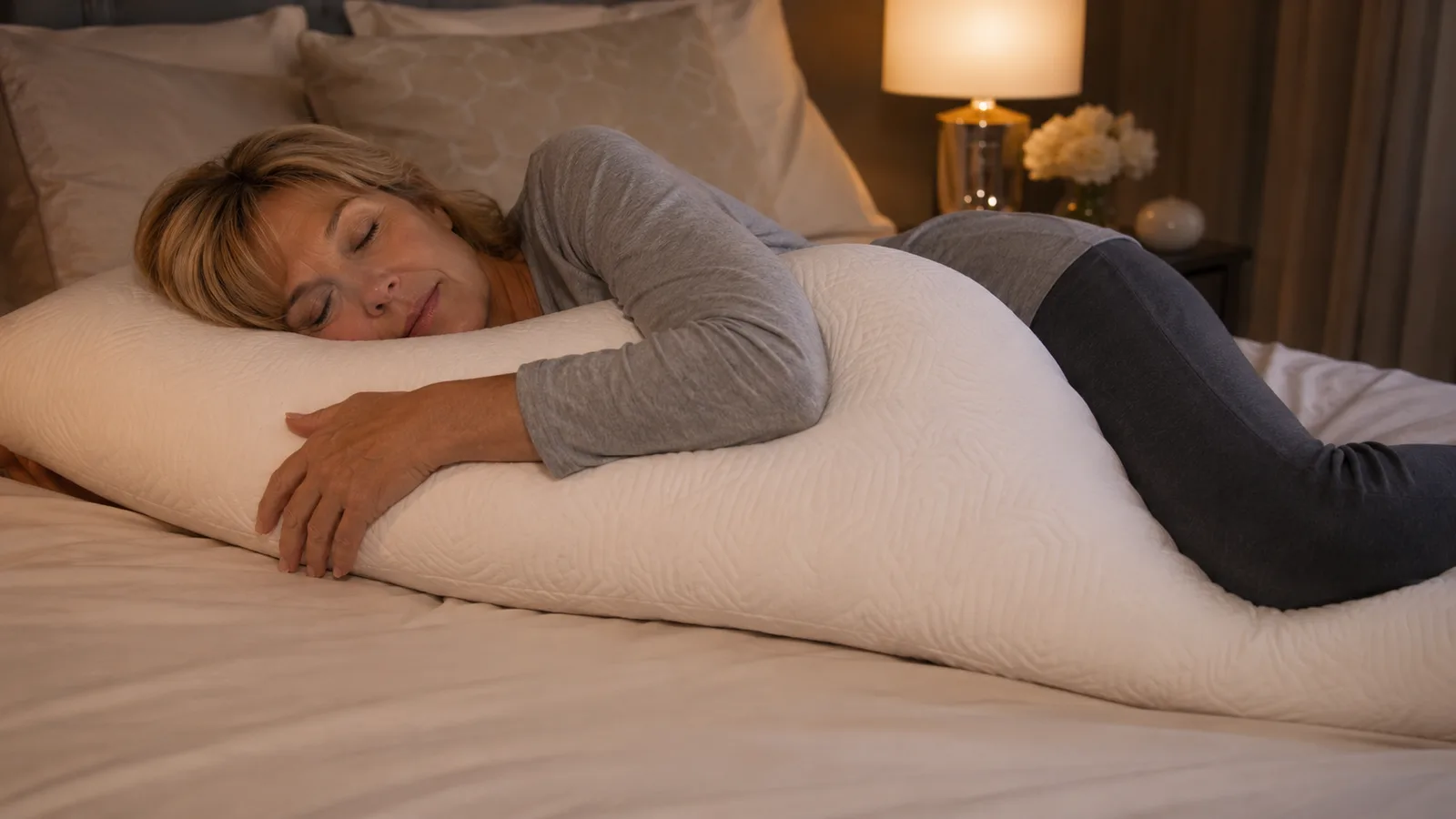
For twenty-three years I worked night shifts as a critical care nurse, which meant sleeping in daylight hours while my joints ached from being on my feet twelve hours at a stretch. My hips took the worst of it. By the time I stepped back from bedside nursing, I could not lie on my side for more than twenty minutes without my top leg dragging my spine out of line and my hip aching enough to wake me. Danny, my husband, used to find me sitting up at 3 p.m. (my version of the middle of the night) rubbing my hip like I was seventy instead of fifty-something. A body pillow did not fix everything on its own, but positioning one correctly changed how I slept more than any mattress upgrade or new head pillow ever did.
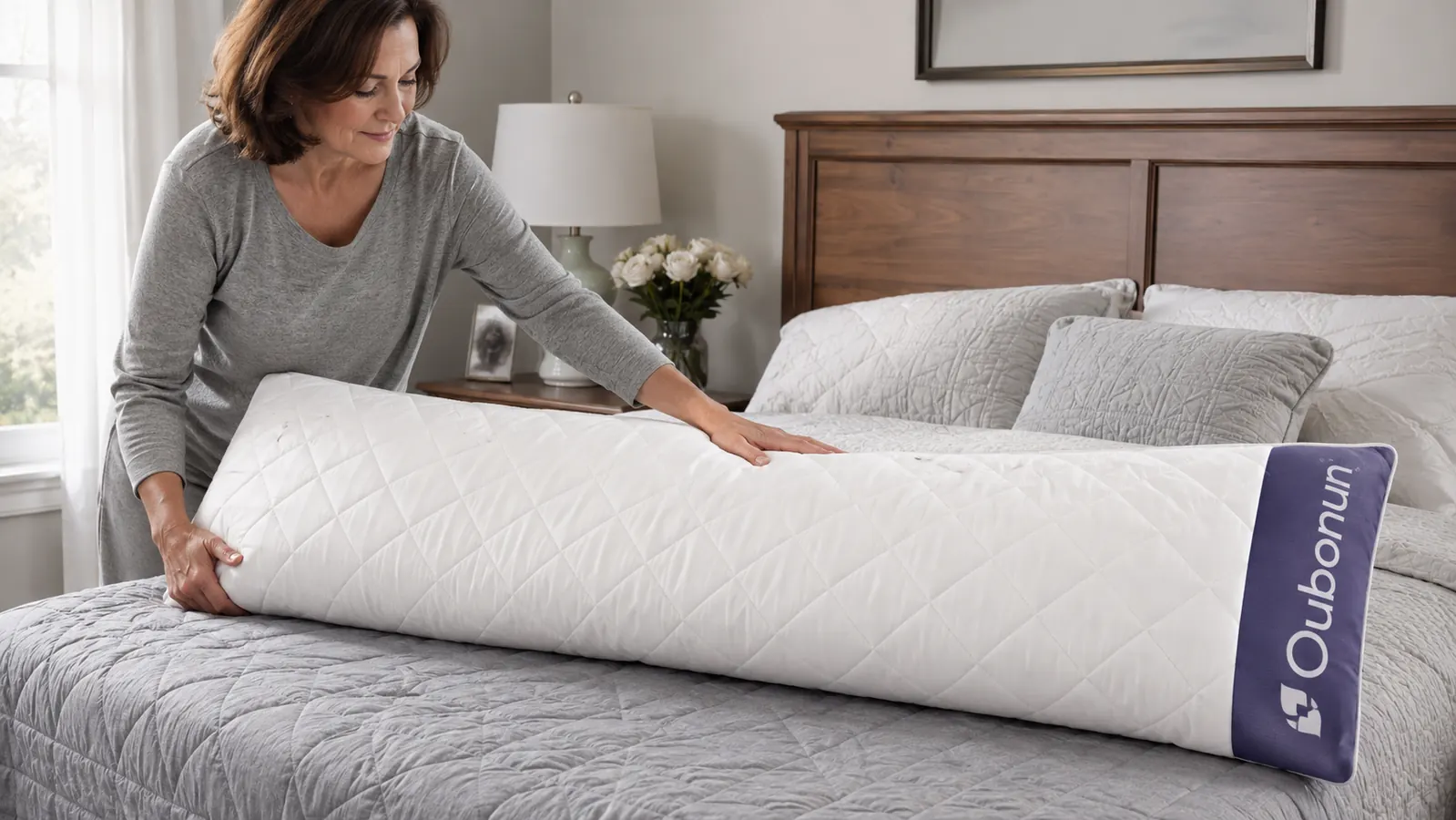
The pillow I use now is the Oubonun Adjustable Loft Quilted Body Pillow, a 21 by 54 inch down alternative pillow with a zippered fill panel that lets you add or remove stuffing to change the loft. That adjustability matters more than most people realize, because a body pillow that is too flat lets your hips roll forward through the night, and one that is overstuffed pushes your top shoulder out of line instead of supporting it. Below is the exact routine I walk my adult kids and my patients' family members through when they finally ask me how to actually use one of these things, instead of just draping it across the bed and hoping for the best.
Before You Buy Another Pillow, Fix How You're Using the One You Have
Most people who tell me a body pillow "didn't work" were using the wrong size or the wrong loft for their frame. The Oubonun Adjustable Loft Body Pillow solves that second problem by letting you customize the fill yourself, which is the single biggest reason I recommend it over the fixed-fill pillows I tried first.
Amazon Check Today's Price on Amazon →None of these five steps require anything fancy. What they require is doing them in order, and giving the routine more than one night to prove itself, which is the part almost everyone skips.
Step 1: Pick the Right Size and Firmness Before You Position Anything
A body pillow that's too short will leave your ankles and lower calves unsupported, which is a bigger deal than it sounds like when you have any hip or lower back sensitivity. I'm 5'6" and the 54 inch length on the Oubonun runs from my collarbone to well past my knees, which is what let me stop stacking a second pillow under my calves. If you're taller than 5'9" or so, measure your own torso-to-knee distance before you buy anything, because a pillow that stops at mid-thigh forces your bottom leg to twist to compensate.
Firmness is the part people get wrong most often. A body pillow that's too soft collapses the moment you put weight on it, so your top hip sinks toward the mattress and your spine curves. A pillow that's too firm won't contour to your waist at all, so you get a gap under your ribs that your shoulder ends up bridging instead. The Oubonun ships firmer than most down alternative pillows I tested, closer to a firm bed pillow than a squishy body pillow, and I actually prefer that because it holds its shape through a full eight hours instead of flattening by 2 a.m.
If it arrives firmer than you'd like, that's where the adjustable loft panel earns its keep. I unzipped mine and pulled out about a handful and a half of the fill during my first week, mostly from the section that sits under my ribs, and left the rest alone. Small adjustments, not dramatic ones. Change too much fill at once and you'll spend another week guessing again.
One more thing worth mentioning here, because a coworker asked me about it after a shift, the cover matters almost as much as the fill. The Oubonun's quilted cotton-blend cover doesn't bunch or slide around under a fitted sheet the way a slicker polyester cover does, which meant I wasn't re-positioning the whole pillow every time I rolled over. If your current body pillow keeps sliding out from under you by 2 a.m., that's often the cover fabric, not your positioning.
Step 2: Position the Pillow Along Your Spine, Not Just Between Your Knees
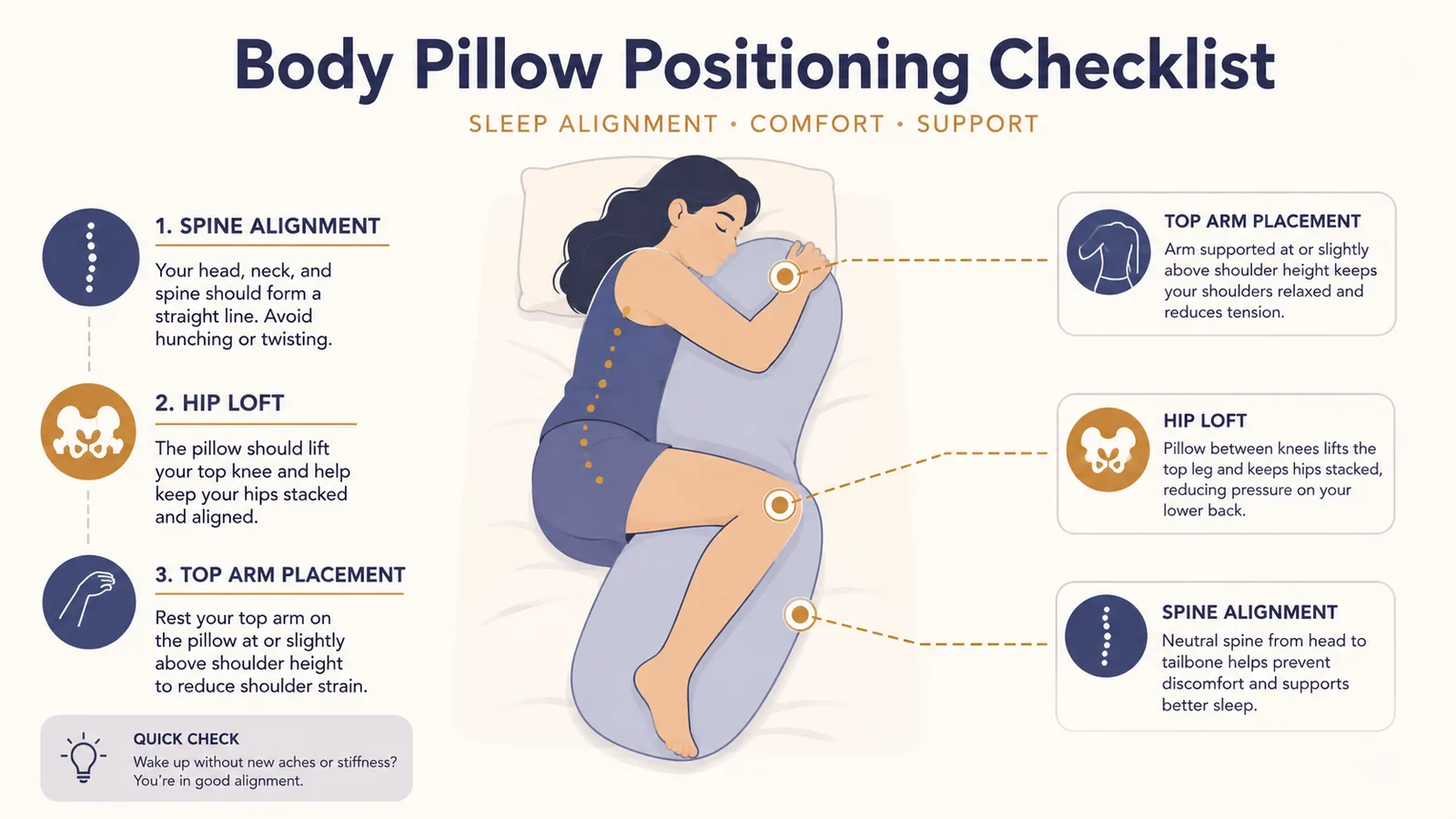
This was the step that changed the most for me, and it's the one nobody explained clearly the first time I bought a body pillow years ago. Don't just wedge it between your knees like a wedge pillow. Hug the top of the pillow against your chest and let it run the full length of your torso, so it's supporting your ribcage and waist at the same time it's between your knees. The Oubonun's length is built for exactly this, front to back contact along your whole side, not just a knee spacer.
Line the pillow up so the thickest part sits roughly where your waist curves in, not up under your armpit. If you find yourself pulling the pillow higher and higher through the night, that's usually a sign the loft is too flat to fill the gap under your ribs, which is worth revisiting once you've read Step 4 below.
I also learned to keep my bottom leg fairly straight underneath the pillow rather than bent at a sharp angle. A slight bend is fine and even helpful for hip alignment, but a sharply bent bottom knee twists the pelvis and undoes a lot of what the pillow is doing for your spine.
Danny caught onto this faster than I did, honestly. He's not a side sleeper by nature, more of a back sleeper who ended up converted after his own shoulder surgery a few years back, and he tends to let the pillow drift down toward his hips overnight instead of keeping it hugged up near his chest. Every few nights I still catch him doing it and nudge it back up for him. It's a habit like any other, and habits take repetition before they hold on their own.
Step 3: Get Your Top Arm and Shoulder Out of the Danger Zone
Side sleepers who wake up with a numb arm or a stiff shoulder are almost always resting their top arm across their own body, compressing a nerve or a blood vessel against the mattress. Drape your top arm over the body pillow instead of across your ribs or under your neck. The Oubonun's width gives your arm somewhere to actually rest, rather than dangling off the edge, which is what happens with the narrower body pillows I tried before this one.
Your top shoulder should roll slightly forward, toward the pillow, rather than staying stacked directly on top of your bottom shoulder. If your top shoulder feels pinned back or your neck feels twisted when you wake up, walk through this positioning again before you assume the pillow itself is the problem. Most of the time it's a two minute fix, not a pillow return.
I noticed the difference most on nights I was covering an extra shift and already running tired. On those nights I'd skip the positioning and just collapse onto the pillow however I landed, and I'd wake up with that pins-and-needles feeling in my forearm almost every time. It's a small thing to double check before you fall asleep, but it's the difference between waking up rested and waking up shaking out your arm.

Step 4: Adjust the Loft to Match Your Hip Width
This is where the Oubonun's adjustable fill panel does the most work, and it's the step most reviews skip entirely. Hip width varies a lot from person to person, and a fixed-loft pillow simply can't account for that. If your hips are wider relative to your waist, you'll likely want more loft under your ribs to keep your spine level. If your waist and hips are closer in width, too much loft there will actually tilt your spine the other direction.
I check mine every few months, honestly, mostly because the fill settles a little with regular washing. Unzip the access panel, redistribute the fill by hand so it isn't bunched at one end, and lie down on your usual side before deciding whether to add or remove more. Give yourself two or three nights after any adjustment before you change anything again. Your body needs time to tell you whether it's actually helping.
If you switch which side you sleep on partway through the night, which most of us do without realizing it, keep the loft slightly more generous than feels perfect on your dominant side. A pillow adjusted exactly right for one side only will feel wrong the moment you roll over, and you don't want to be fully waking up to fix it at 3 a.m. A little extra loft is more forgiving across both sides than a perfectly precise setting for just one.
Step 5: Give the Routine Two Weeks Before You Judge It
This is the step people skip, and it's the reason so many body pillows end up donated after one disappointing week. Your muscles have spent months or years compensating for poor alignment, and they don't let go of that compensation pattern overnight just because the pillow is finally in the right place. I tell my kids the same thing I tell myself, expect the first three or four nights to feel a little unfamiliar, not necessarily better.
Keep a simple note on your phone of how you woke up each morning, stiff, fine, or better than usual, so you're tracking your own pattern instead of relying on memory. By night ten or eleven with the Oubonun consistently positioned the way I described above, I was waking up without that first-thirty-seconds hip ache I'd had for years. That timeline will vary person to person, but two weeks of consistent use is a fair trial before you decide a body pillow isn't for you.
What Else Helps
A body pillow does a lot of the alignment work, but it isn't solving for everything. The mattress underneath you still matters, a mattress that's sagged in the middle will undo good pillow positioning no matter how carefully you follow these steps. So does your head pillow height, if it's too high or too low relative to your shoulder width, your neck stays out of line even when your hips and spine are well supported. And if you tend to run warm overnight, a body pillow with a breathable quilted cover, which is what the Oubonun uses, matters more than people expect, because a hot, damp pillow is one you'll unconsciously push away from your body by 4 a.m.
A short stretch before bed helps too, though I'm careful not to oversell it. Nothing elaborate, just a couple of minutes of hip flexor and lower back stretches while I'm brushing my teeth, done consistently, has made the positioning routine above easier to settle into. I'd rather give you one honest tip than a long list of things you'll never actually do. The body pillow is doing the heavy lifting here. Everything else is just supporting cast.
The pillow doesn't fix your alignment. It holds the alignment you set up in the first place, which is why the positioning matters more than the pillow itself.
Ready to Actually Sleep Through the Night on Your Side
If you've read this far, you already know more about positioning a body pillow than most people who own one. The Oubonun Adjustable Loft Body Pillow is the one I've used through this entire routine, and the adjustable fill is what makes these five steps possible in the first place.
Amazon Check Today's Price on Amazon →